Metals & Alloys

Ceramics & C/C Composites

R&D / QC

Propulsive & Propellants

宇宙・高機能材料分野の進歩は、金属、合金、先端材料に関する最先端の研究に支えられています。
航空宇宙部品から過酷な環境に対応する高性能構造まで、成功の鍵は精密なエンジニアリングと厳格な品質基準です。 当社の技術は、粒子特性評価、元素分析、熱処理、機械試験、試料調製を通じて、航空宇宙用高機能素材の材料科学における革新と信頼性を実現します。
私たちの専門的でプロフェッショナルなチームは、完璧なソリューションを見つけるためにあなたをサポートします!
Modern rocket engines are now routinely manufactured using advanced 3D printing techniques, enabling optimal structural stability, reduced weight, and integrated cooling channels that were previously impossible to produce with conventional methods. This breakthrough in additive manufacturing has transformed the production of complex components such as missile parts and aircraft engine elements, where performance and reliability are paramount.
In these applications, metal powders—especially titanium and steel—play a critical role. For processes like 3D printing or thermal spray coating, the powders must exhibit tightly controlled particle size distributions to ensure consistent and reliable processing. Generally, spherical particles within a narrow size range are preferred, as they flow more easily and can be deposited more uniformly. However, if the size range is too narrow, packing density decreases, potentially leading to voids and inhomogeneities in the final component.
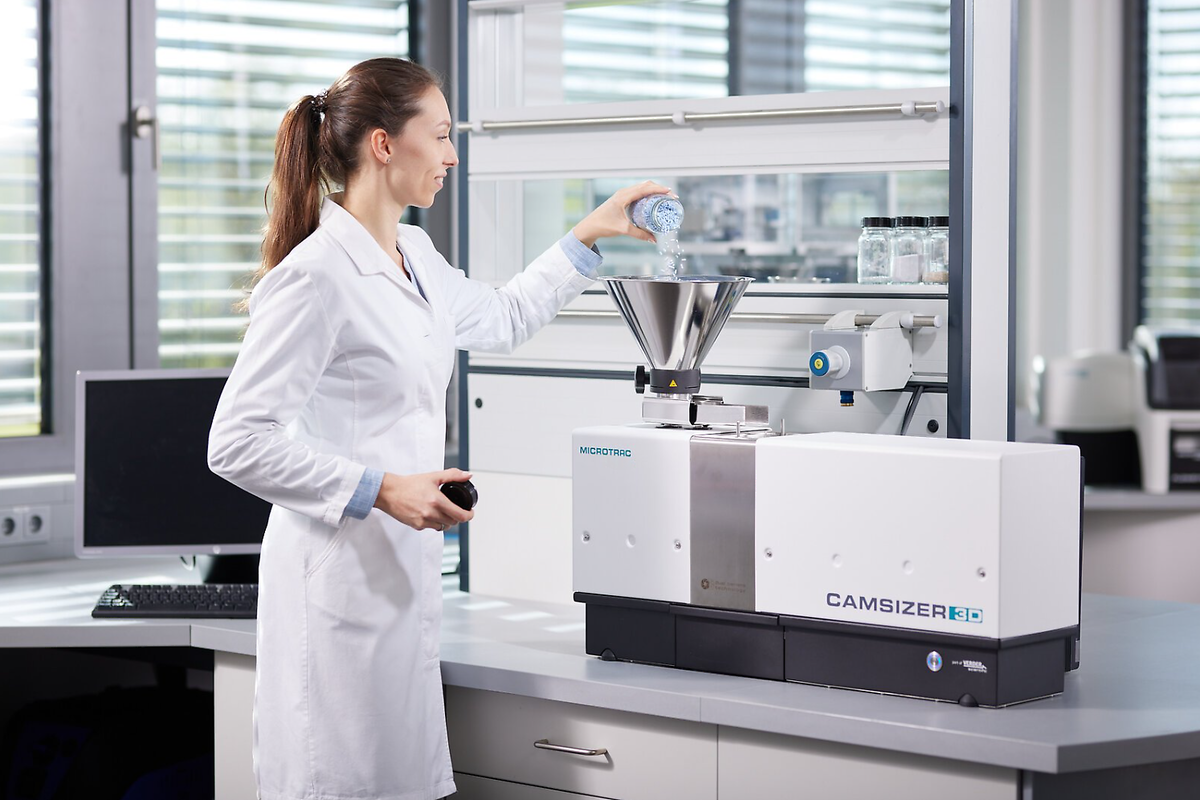
Microtrac offers a comprehensive portfolio of technologies for analyzing particle size and shape, including both dry and wet dispersion methods. Their systems are designed to meet the stringent demands of aerospace and defence manufacturing. In this application note, Microtrac demonstrates how Dynamic Image Analysis (DIA) — as implemented in the CAMSIZER X2 - provides deep insight into powder quality. Unlike traditional sieving, DIA can detect even 0.005% of oversized particles, ensuring that only powders meeting the highest standards are used in production.
Quality control for Metal Powder and Powder Metallurgy process based on particle size and morphology with Laser diffraction
Advanced particle characterization of metal powders - especially for additive manufacturing and powder metallurgy - highlighting the need for spherical, broad size distribution powders to ensure optimal flowability, packing density, and final part integrity.
SYNC instrument uniquely integrates laser diffraction with dynamic image analysis to detect both size and shape - including agglomerates, satellites and oversize particles - in a single automated run.
Surface area analysis of metal powders is crucial in defence and security applications, where material performance under extreme conditions is paramount. The specific surface area influences properties such as reactivity, sintering behavior, and mechanical strength, which are vital for components like armor, propulsion systems, and additive manufacturing parts.
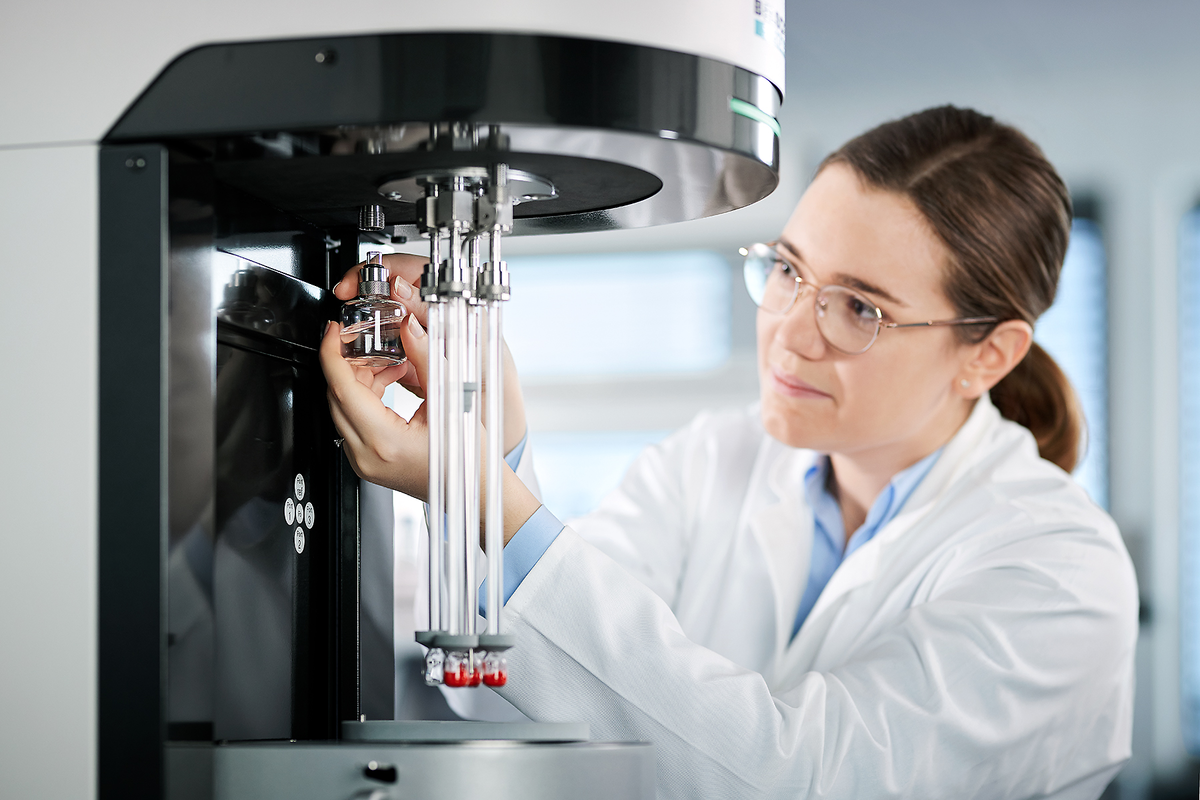
Microtrac's BELSORP series, including the BELSORP MAX X, MAX G, and MINI X, offers advanced capabilities for precise surface area and pore size distribution measurements. These instruments utilize gas adsorption techniques, adhering to standards like ASTM B922 and ISO 9277, ensuring reliable and reproducible results.
Have a look to the list of Standard compliance to Microtrac product:
The BELSORP MAX X stands out with its ability to analyze up to four samples simultaneously, covering a wide range of pressures and temperatures. It supports various adsorbates, enabling comprehensive characterization of materials. The BELSORP MAX G, with its ultra-low pressure measurement capability, is ideal for evaluating micro-, meso-, and macroporous materials.
Accurate density measurement of metal powder alloys is critical in defence and security applications, where material performance and structural integrity are paramount. The Microtrac BELPYCNO series offers precise determination of true and skeletal density using gas displacement methods, typically with helium.
These instruments are essential for evaluating metal powders used in additive manufacturing, sintering, and ballistic components. Understanding the true density helps detect porosity, assess powder quality, and ensure consistency in components such as armour plating, missile parts, and aerospace structures.
Microtrac's gas pycnometers comply with international standards, including ASTM B923 for skeletal density of metal powders and ISO 12154 for gas pycnometry . These standards ensure that measurements meet the stringent requirements of defence material specifications.
Or this one related to Density measurement of 3d printer additive molding materials by gas displacement method:
Defence equipment relies on high-grade metals – from steel armor plates and gun barrels to titanium airframe and engine parts. The mechanical properties (strength, hardness, toughness) of these metals are directly influenced by their carbon, sulfur, and other elemental content. For example, carbon and sulfur substantially influence the hardness and workability of steels and titanium.
ELEMENTRAC CS-i analyzer uses a powerful induction furnace (oxygen atmosphere >2000 °C) with infrared detection to accurately quantify carbon and sulfur in metal samples.
Precise oxygen and hydrogen testing on different alloys. Especially oxygen determination in titanium is one of the most common analysis for flight-critical components.
Likewise, oxygen, nitrogen, and hydrogen content in metals are critical – excess oxygen or nitrogen can embrittle titanium and steel, and hydrogen can cause dangerous cracking (hydrogen embrittlement) in high-strength alloys.
Eltra’s inert-gas fusion analyzers (like the ONH series) measure these light elements at ppm levels. ELEMENTRAC ONH-p can determine O, N, H in metals or even ceramics with an impulse furnace up to 3000 °C. This capability is used, for instance, to certify aircraft-grade titanium or to ensure a batch of specialty steel for a submarine hull has no excessive hydrogen that could compromise integrity.
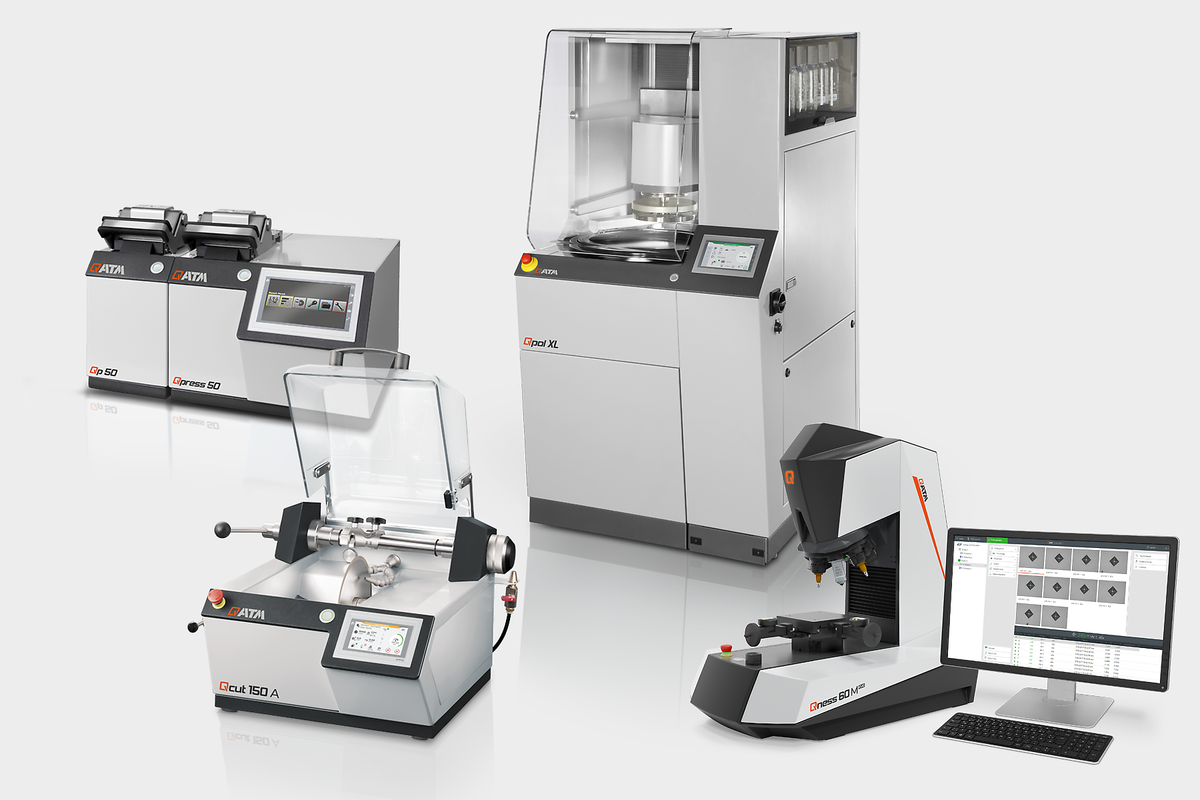
航空工学の高機能性材料では、金属粉末の材料組織学的分析が不可欠であり、粉末冶金や積層造形によって製造される部品の信頼性と性能を確保が必須です。QATMは、金属組織試料の調製と分析に関する包括的なソリューションを提供し、航空工学.宇宙工学に不可欠な微細構造の詳細な検査を可能にします。
ASTMの『金属組織試料および材料組織試料の調製、光学顕微鏡、画像解析、硬さ試験』(Metallographic and Materialographic Specimen Preparation, Light Microscopy, Image Analysis and Hardness Testing)は、この分野における主要な参照文書のひとつです。
試料調製プロセスは、代表性のある試料を得るために、薄いCBNブレードを備えた精密切断機による正確な切断から始まります。
QATM's extensive application notes and preparation methods database offer detailed protocols tailored to specific materials and processes, supporting the development and quality assurance of defence-related components.
ホットマウント工程では、Qpressシリーズのようなプレス機を用いて試料を樹脂で包埋し、取り扱いを容易にするとともに、研磨やポリッシングの際に繊細構造を保護します。この工程は、試料の微細構造の完全性を維持するために極めて重要です。
研磨およびポリッシングは、半自動機を使用して行われ、正確な顕微鏡分析に必要な均一な表面に仕上げます。高機能金属で一般的に使用される鋼やニッケル基超合金を含むさまざまな材料に対応しています。
最終試験では、硬さ試験と顕微鏡観察により粒径や相分布を評価します。これらの評価は、運用時の応力下における材料挙動を予測するうえで不可欠です。
金属で所定の機械的特性を得るためには、焼入れ、焼戻し、焼なましなどの熱処理が必要とされます。Carboliteの炉は、AMS2750(NADCAP)などの航空宇宙向け熱処理規格に準拠するよう構成でき、この分野の生産ラインや研究開発ラボで広く使用されています。
例えば、ニッケル超合金製のジェットエンジンのタービンブレードは、適切な結晶構造を形成するために、制御された雰囲気下で正確な高温サイクルを経る必要があります。Carboliteのチャンバー炉や真空炉は、これらのプロセスに必要な均一な高温と精密な制御を提供し、規格準拠と校正トレーサビリティを保証します。
研究者は高エネルギー型ボールミルを用いて、メカニカルアロイングを実施できます。このプロセスでは、異なる金属の粉末を混合・粉砕し、新しい合金やナノ構造材料を作製します。
この分野の研究者は、反応性材料向けの軽量合金や準安定相を探索する際、溶融では作製できない少量の材料をこの方法で製造します。
当社のアプリケーションノート『航空宇宙産業における試料調製ソリューション』(Solutions for sample preparation in the aerospace industry)では、Retschが提供するソリューションを詳しく紹介しています。
たとえば、セラミックナノ粒子を含有した新しいアルミニウム合金の開発が挙げられます。粉末を集中的に粉砕して、セラミックを金属マトリックスに均一に分散させます。この手法は、高機能性素材における超合金や複合粉末の作製に重要であり、水素貯蔵合金やセンサー用の新しい磁性材料などの開発にも活用されています。
高性能セラミックス(例:装甲板用の炭化ホウ素やエンジン部品用の酸化物セラミックス)、およびカーボン/カーボン複合材は、その製造に微細な粉末や前駆体を必要とします。 カーボン/カーボン複合材は、炭素繊維を炭素マトリックスに埋め込んだ先進材料であり、卓越した強度、熱安定性、そして過酷な環境耐性で知られています。
Inconel 718は、卓越した機械的特性と過酷な環境への耐性により、航空宇宙の高機能性素材として不可欠な高性能ニッケル・クロム合金です。この合金は、最大約1300°F(約704℃)までの温度で優れたクリープ破断強度を発揮し、ジェットエンジン、ロケットモーター、ガスタービンなどの高応力用途に最適です。
航空宇宙分野では、Inconel 718は高速機体部品の製造に広く使用されており、ホイール、バケット、スペーサー、高温ボルトやファスナーなどに採用されています。高温下でも構造的完全性を維持し、酸化や腐食に耐える能力により、航空宇宙部品の信頼性と耐久性を確保します。
Verderグループは、Inconel 718の製造および品質管理において、さまざまなソリューションを提供できます。
硬さは宇宙工学材料にとって基本的な特性であり、強度、耐摩耗性と直接相関し、構造部材の場合には極限環境での性能を示す重要な指標となります。材料の硬さは、宇宙機器の性能、耐久性、信頼性にとって極めて重要です。
QATMは、ビッカース、ブリネル、ロックウェル、ヌープといったすべての標準的な方法を網羅した硬さ試験ソリューションを包括的に提供しています。薄膜や微細な組織のための微小硬さ試験から、バルク金属のためのマクロ硬さ試験まで対応可能です。宇宙工学の品質保証ラボでは、QATMの硬さ試験機が、耐熱合金や複合材の各ロットに対するロックウェル硬さチェックに日常的に使用され、適切な熱処理が施されていることを確認します。
これらの試験は、材料が厳格な宇宙産業仕様に準拠していることを検証するために不可欠であり、その仕様にはしばしばASTM E18(ロックウェル)やASTM E384(ビッカース硬さ試験)などの規格が参照されます。QATMの高精度機器には、自動試料ステージや高度な画像処理機能が搭載されており、試料の複数箇所で効率的かつ正確な試験を可能にします。
衝撃試験も、Q10A+マイクロ硬さ試験機で実施されます。
チューブ炉や黒鉛エレメント炉などCarboliteの先進的な炉は、技術セラミックスや炭素-炭素(C/C)複合材といった最先端材料の製造・試験において重要な役割を果たしています。これらの材料は宇宙工学分野で広く利用されています。C/C複合材の製造では、ポリマー含浸炭素繊維部品を不活性雰囲気中で徐々に加熱し、樹脂を炭化させる「熱分解(Pyrolysis)」工程を経て、さらに高温での黒鉛化により材料特性を向上させます。Carboliteは、炭素繊維や炭素複合材の研究開発向けに、バインダー除去用炉(約800℃でバインダーを除去)や炭化・黒鉛化用の高温炉(約2500~3000℃まで到達可能)を提供しています。 これらのシステムにより、極限の熱と応力に耐えるC/C部品―例えばロケットノズルインサート、宇宙機の先端部材、航空機ブレーキディスク―の製造が可能になります。たとえば、バージニア大学では、Carboliteの高温炉(モデルLHTG 200-300)を用いて、プリセラミックポリマー材料からセラミックスを製造し、不活性雰囲気下で最大3000℃まで加熱することでポリマーをセラミック部品へと変換しています。 シリコンカーバイドセラミックマトリックスや超高温複合材など、極超音速機の外装など宇宙工学研究に直接関係する材料開発を支えています。 These systems enable the manufacture of C/C components such as rocket nozzle inserts, missile nose cones, and aircraft brake discs, all of which must withstand extreme heat and stress.For example, at the University of Virginia, a high-temperature Carbolite furnace (model LHTG 200-300) is used to fabricate ceramics from preceramic polymer materials, facilitating the transformation of polymers into ceramic components under an inert atmosphere at temperatures up to 3000 °C.
Such capabilities are directly relevant to defence research, supporting the development of materials like silicon carbide ceramic matrices or other ultra-high-temperature composites for applications such as hypersonic vehicle surfaces.
The sample preparation process is really important to ensure good and reliable results. The use of the right milling system is essential to obtain the right results, and we can divide the needing:
Carbon determination and Thermogravimetric analysis are important for carbon-carbon composites and carbon-fiber-reinforced polymers (CFRPs), as it helps determine char yield and residual resin content - critical parameters for quality control and performance assessment.
Measuring the total oxygen in aluminum or ceramic powders provides an indirect indicator of how much surface oxidation has occurred: in powders where oxygen resides mainly in the surface film, a higher oxygen level generally corresponds to a thicker oxide layer, which in turn governs reactivity, sintering and final properties. Consequently, routine oxygen analysis—supplemented by surface-specific techniques—is standard practice for quality control in aerospace and defence powder processing.
Both types of analyses are standard practices in materials science for ensuring the desired properties and performance of advanced materials, particularly in aerospace and defence applications.
ELTRA’s versatility allows testing of powders, fibers, and finished parts. ELTRA analyzers (such as the ELEMENTRAC ONH and CS series) use resistance or induction furnaces that reach very high temperatures (up to 3000 °C), ensuring the complete decomposition even of highly stable materials like C/C composites or ceramics. This enables accurate determination of carbon, oxygen, and other light elements. Additionally ELTRA hardware is designed to minimize cross-contamination between analyses, thanks to automatic cleaning systems and easily washable combustion chambers.
Particle size and shape of ceramic powders or carbon composite is useful to predict sintering behavior and final microstructure.
There are specific challenges in performing particle size analysis on materials such as advanced ceramics and carbon-carbon composites, mainly due to their unique physical and structural properties. Ceramics and carbon-based composites tend to agglomerate due to van der Waals forces or surface charges.
This can make it difficult to obtain an accurate and representative particle size distribution without proper dispersionю With the use of dynamic image analysis/laser diffraction instruments like the Microtrac CAMSIZER X2 and Microtrac SYNC it is possible to differentiate primary particles from agglomerates.
These materials often have non-spherical particle shapes, which can affect results from instruments assuming spherical models. Use analyzers that provide both size and shape data, such as those based on image analysis.
For C/C composites (carbon fiber reinforced carbon, used in missile nose tips, rocket nozzles, aircraft brake discs due to their ability to withstand extreme heat), porosity is a critical parameter. These composites are made by infiltrating a carbon fiber preform with resin or pitch and carbonizing, often repeated to densify. The final material typically still contains some residual porosity. The size of those pores (micro-porosity within the carbon matrix vs larger voids) can affect the composite’s mechanical strength and ablation resistance.
Characterizing the pore size distribution in a C/C composite can be done via gas adsorption for micropores and mesopores, and mercury intrusion for larger pores.
For instance, activated carbon is used in gas mask filters and collective protection systems to adsorb chemical warfare agents. The efficacy of these carbons is directly related to their surface area and pore structure. A high surface area (1000+ m²/g) with appropriate pore sizes (micro- and mesopores) allows them to capture toxic molecules effectively.
BELSORP are commonly used to characterize such materials: they measure nitrogen adsorption isotherms at 77 K to calculate BET surface area and apply DFT methods to ascertain pore size distribution. An example is a study on activated carbon fibers intended for absorbing a mustard gas simulant (2-CEES).
READ THE ARTICLE FROM MDPI
宇宙・高機能材料分野では、最高水準の品質と性能を維持することが不可欠です。研究開発(R&D)チームや品質管理(QC)部門は、材料や部品が厳格な仕様を満たしていることを確認するため、先進的な分析技術に依存しています。 Verderグループは、これらの重要なプロセスを支援するため、元素分析、熱処理、粒子特性評価、材料組織観察・硬さ試験、粉砕・ふるい分けなど、幅広いソリューションでそのニーズに応えます。
The Dumas method involves high-temperature combustion of a sample in an oxygen-rich environment, converting elements into their gaseous forms (e.g., C into CO2, N into N2). These gases are then passed through filters and thermal conductivity detector (TCD) for nitrogen and infrared cells for carbon dioxide determination. This provides total nitrogen and carbon content within minutes.
This determination is important in propellants to determine the composition of energetic materials like nitrocellulose, where nitrogen content directly relates to energy potential and stability. The study of Carbon and Nitrogen assures batch consistency in gunpowder and propellants by verifying expected carbon/nitrogen ratios. Also the C/N content is used to support forensic/military identification and aging analysis of materials.
In the defence sector, where high-performance alloys such as armor-grade steels, aerospace light alloys, and artillery materials are employed, metallography plays a crucial role both in the development of new materials and in the quality control of manufactured components.
The objective is to identify microstructural features that directly affect the mechanical properties and in-service behavior of the component.
The metallographic process involves extracting a specimen from the material of interest, mounting it in resin for ease of handling, and polishing it meticulously to a mirror finish. The polished surface is then chemically etched with a suitable reagent (acid or specific solution) to reveal grain boundaries and phase distinctions.
The prepared specimen is subsequently examined under an optical metallurgical microscope at various magnifications (typically 50x, 100x, 500x, or 1000x) using reflected light.
Microstructural evaluation can be qualitative (e.g., “tempered martensitic structure with dispersed carbides”) or quantitative, using image analysis software. Quantitative assessments may include:
Many materials used in the defence sector are found in the form of powders or porous solids (for example, granulated explosives, composite solid propellants, rocket catalysts, and adsorbents for gas masks).
A key property of these materials is their specific surface area. This property is commonly measured in m2/g using gas adsorption techniques at cryogenic temperatures, typically by applying the BET (Brunauer–Emmett–Teller) method. From the resulting adsorption isotherm, the BET model calculates the total surface area required to account for the observed amount of adsorbed gas.
The specific surface area of an explosive powder has a direct influence on its behavior. In general, a larger surface area (finer or more porous particles) leads to higher reactivity. For instance, in solid propellants, the burn rate is closely linked to the available surface area of the propellant grain exposed to combustion. Therefore, in ballistic design, both particle size distribution and surface area must be carefully optimized to ensure stable and safe combustion.
In a quality control context, measuring the specific surface area of a batch of gunpowder or explosive allows for verification that it falls within the desired range.
The long-term stability of such materials can also be monitored: powders may aggregate or form larger crystals during storage (reducing surface area), or conversely, break apart (increasing it). Gas adsorption is therefore valuable for detecting such changes over time.
In addition to calculating mean specific surface area (typically from the linear region of the BET isotherm), gas adsorption techniques also provide insights into material porosity. Using methods such as BJH (Barrett–Joyner–Halenda), the distribution of internal pore sizes can be determined.
In a defence R&D setting, for instance, one might develop a new explosive with a controlled crystalline microstructure containing nano-sized pores. The goal could be to reduce sensitivity to mechanical shock while maintaining sufficient surface area to ensure a high detonation velocity. BET analysis would be crucial in validating how crystallization processes affect the final product.
Besides fabrication, heat treatment equipment is used to test material behavior under heat. Carbolite’s ashing furnaces (e.g., used to burn off organic content at ~600–800 °C) can determine the ash content of composites or the purity of a propellant by incinerating samples and measuring residue.
For example, an armor manufacturer might ash a sample of a ceramic composite plate to verify the fiber vs. matrix ratio (burning away the polymer and weighing the ceramic ash). High-temperature furnaces can also simulate service conditions: a lab may heat a sample of armor steel or protective coating to see how it oxidizes or degrades at elevated battlefield temperatures.
Carbolite tube furnaces with controlled atmospheres could be used to perform oxidation resistance tests on coatings for naval engine components or to subject electronic components to prolonged high-temp exposure as a part of stress testing.
粒子特性は、燃焼速度、流動性、充填密度といった材料の挙動に直接影響します。代表的な用途としては:
The burn rate and stability of propellants (like nitramine gun propellants or rocket fuels) and high explosives are highly sensitive to particle size. In fact, U.S. military specifications mandate Microtrac analysis for certain propellants to verify that material is within required limits.
The particle size distribution shall be as shown below:
| Distribution (percentile-weight %) | Microns | ||||
| 10% | 1.4+/-0.1 | ||||
| 50% | 4.2+/-0.3 | ||||
| 90% | 10.5+/-0.5 | ||||
| Mean | 5.2+/-0.5 | ||||
In propellants (such as composite solid rocket propellants or gun propellants), the particle size of ingredients like oxidizers (e.g. ammonium perchlorate) and metal fuels (e.g. aluminum powder) must be carefully optimized. Fine particles contribute to higher burn rates, whereas coarse particles can slow the burn; a bimodal distribution is often used to pack density and tailor the burn profile. Studies have shown that increasing oxidizer or fuel particle size (thereby lowering surface area) can reduce the burn rate of a propellant because less surface is available for the combustion reaction.
Microtrac laser diffraction and image analysis systems provide rapid, precise measurements of granular explosives and oxidizer powders to ensure they meet design specifications.
Would you like to have more information?
Microtracのレーザーおよび光学式アナライザーは高度な粒度測定を提供していますが、ふるい分け試験は品質管理において粒度分布を測定するためのシンプルで規格準拠の方法として依然有効です。ロケット推進剤用アルミニウム粉末を製造するプラントでは、例えば「90%が150µmを通過し、50µmで保持される」という仕様を満たすために粉末をふるい分けし、適切な燃焼特性を確保しています。 この測定を再現性高く実施できるRetsch製品は、ふるい分け試験はまた、ロケット施設など砂や土の粒度評価や、砂漠環境の粉塵が車両フィルターに影響するサイズ範囲に収まっているかを確認にも有用です。 Retschは、最高の性能を保証するためにさまざまなソリューションを提供しています。アプリケーションレポートをご覧ください。
| HMX Type | Size Range (µm) | Key Use | ||||
| Type A | 45–150 | Castable explosives | ||||
| Type B | 10-44 | Pressed compositions | ||||
| Ultrafine | <10 | Propellants, boosters | ||||
High Melting Explosive (HMX) demands strict particle size and morphology control to optimize burn rates, packing density, and polymorphic stability. Crystallization methods—like ultrasound-assisted transformation and CO2-supercritical precipitation—can yield HMX particles from sub-5 µm to over 300 µm. Typical standards (e.g., MIL-DTL-45444A) require narrow particle size distributions and minimal agglomeration.
The Microtrac SYNC combines laser diffraction and dynamic image analysis in one system, uniquely identifying fines, oversize particles, satellites, and shape anomalies—all crucial for HMX quality and safety.
For pyrotechnics and propellants, knowing the BET surface area is useful for predicting how quickly a material might ignite or how much binder may be needed to coat particles. In one defence-related study, ultrafine RDX (Cyclotrimethylenetrinitramine) explosives were synthesized and characterized by BET surface area along with other techniques, confirming that the ultrafine particles had increased surface area and different sensitivity compared to standard-grade material.
For instance, the BELSORP-Max can measure multiple samples simultaneously across a range of pressures to determine not only surface area via multi-point BET but also mesopore volume via the BJH method, which could be applied to quantify pore volume in propellant powders or catalyst particles used in propellant formulations.
Interested?
TGA is a valuable technique in defence materials research. With this technique is possible to determine the thermal stability of energetic compounds (ensuring an explosive or propellant will not decompose or lose mass below its intended operating temperature), measure the content of binders or volatiles in composites, or quantify moisture content in powders (critical for powders that must stay dry to remain stable).
Would you like to learn more?
How fine is the very first Moon soil we ever held? McKay and colleagues fire a Microtrac laser-diffraction analyzer at Apollo 11 sample 10084, capturing sub-micron grains that old-school sieves missed entirely.
Cooper et al. turn Microtrac laser diffractometer on Apollo 11 soil to count grains small enough to reach an astronaut’s alveoli.
Suspecting that decades of Earth-humidity might grind Apollo 17 “orange” soil 74220 into ever-smaller grains, Taylor’s team re-measures it—after repeated wet-dry cycles—using laser-diffractometry (Microtrac).
Robens and co-authors combine adsorption experiments with grain-size spectra from a Microtrac Bluewave laser diffractometer to link nanoscopic roughness to water and hydrocarbon uptake in Apollo 11, 12 & 16 soils.
日本国内にサービスチームがあるので、もしもの時も安心。
お客様に高品質なサービスを提供するため、子会社や現地営業所の幅広いネットワークを持っています。サンプルテスト、アプリケーションレポートの閲覧など、様々なサービスを提供することができます。